 Buddha Sutras |
 |
Mantras Sanskrit |
| Home | Introduction | Sutras | Translators | Mantras | Prayers | Sanskrit | Glossary | Email Us |
Buddha Sutras |
|
Mantras Sanskrit |
| Home | Introduction | Sutras | Translators | Mantras | Prayers | Sanskrit | Glossary | Email Us |
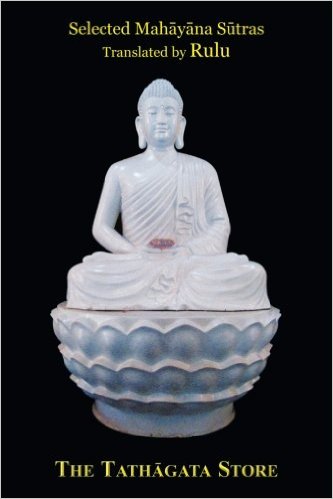 Book information on Home page
Then a Tathāgata observes all sentient beings in the dharma realm with His hindrance-free pure wisdom-eye and speaks these words: “Amazing! Amazing! Why do these sentient beings, deluded and confused, not know and not see that they have a Tathāgata’s wisdom? I will teach them the holy path, enabling them to discard forever their attachments and deluded perceptions. Then they will be able to see within themselves vast Tathāgata wisdom, no different from a Buddha’s.”
—Mahāvaipulya Sūtra of Buddha Adornment, fascicle 51
Translated from the digital Chinese Canon (T10n0279, 0272c25–0273a1)
The above passage in the 80-fascicle Chinese version of the Mahāvaipulya Sūtra of Buddha Adornment (Buddhāvataṁsaka-mahāvaipulya-sūtra) explains clearly why Śākyamuni Buddha (circa 563–483 BCE) appeared in this world. To suit the varied capacities and preferences of all sentient beings, the Buddha has taught 84,000 Dharma Doors. Each is a spiritual entrance through which one can eventually realize one’s own Buddha mind and its infinite wisdom. Since the Dharma came to the West in the twentieth century, there has been growing interest in finding the truth about life and the universe through the teachings of the Buddha. Three Dharma Doors have found large followings in the West: Theravāda students practice the Four Abidings of Mindfulness; Chán students mostly practice “sitting only” introduced by the Japanese Soto School; and students that follow Tibetan Tantrism practice mantra recitation with visualization of a deity. All of them generally recognize the benefits to their lives from their meditation practices.
Relatively unfamiliar to and, perhaps, misunderstood by the West is the Pure Land School, originated in China, which upholds the teachings in five sūtras and one treatise. For example, in the Amitābha Sūtra (Sūtra 23), Śākyamuni Buddha says, “Therefore, Śāriputra, if, among good men and good women, there are those who believe [my words], they should resolve to be reborn in that land.” Taking the Buddha’s instruction to heart, the devotees of this school strive, as their immediate goal, to be reborn in Sukhāvatī, Amitābha Buddha’s Pure Land of Ultimate Bliss. In that splendid environment and in the excellent company of advanced Bodhisattvas, one will attain Buddhahood with Amitābha’s training and support, bypassing the long Way to Buddhahood through one’s cycle of birth and death in the Three Realms of Existence. However, one may choose to return to our impure world any time for delivering sentient beings if one feels compelled and able to do so.
That Buddha has two names in Sanskrit: Amitābha means infinite light, describing His wisdom, and Amitāyus means infinite life, describing His dharma body (dharmakāya), which is beyond the concept of space and time. Chinese Buddhists call Him Amituo, omitting the fourth syllable in either Sanskrit name. He was once a monk named Dharmākara (法藏), who, resolved to attain Buddhahood, had made forty-eight vows to form His splendid Buddha Land and to draw aspiring sentient beings there. One of His vows states that everyone can be reborn there by saying His name in earnest faith even with only ten repetitions (vow 18 in Sūtra 25).
The Pure Land School does not claim that rebirth in Amitābha Buddha’s Pure Land can be achieved through faith only. There are three requirements: faith, resolve, and training. The devotees train either in thinking of Amitābha Buddha with appearance, such as saying His name, visualizing His image and His land, and reciting His mantra (Mantra 5 or 6), or in thinking of Him in the back of one’s mind without appearance. Thinking of Amitābha Buddha is their way to practice śamatha; being vigilant in their thinking is their way to practice vipaśyanā.
When ordinary beings die, karmic forces arise from their minds, driving each to be reborn in a karmic life form and in an environment upon which the new life form relies. Therefore, in order to open a pure dimension in one’s mind, it would be imperative to sustain the right thought and unwavering aspiration up to the final moment—quite a challenge for the dying one. Besides, in the afore-mentioned Sūtra 23, Śākyamuni Buddha says, “No one with the condition of few roots of goodness and a meager store of merits can be reborn in that land.” Although the Pure Land School claims that their Dharma Door is the Hard-to-Believe Easy Path, it really may not be that easy.
Nevertheless, hundreds of stories have been well documented to this day of monks, nuns, laymen, and laywomen in China who have trained themselves in the way of the Pure Land School and received excellent signs at death. In addition to having visions of Amitābha and His Pure Land before or upon dying, many foretold their departure dates and actually died on those dates. Other signs have included fragrance, radiance, the crown of the head staying warm for hours after death, the body remaining flexible for days after death, and so forth.
There are those who offhandedly assert that one’s leaving saṁsāra for the Pure Land is an act of uncaring for other sentient beings, and indicates a failure to seek enlightenment in one’s present life. These critics need to be reminded that rebirth of every ordinary being is driven, not by a sense of mission, but by ignorance of the truth and thirsty love of being. Although there are those who are fortunate to have heard the Dharma in their present life, their spiritual attainment is subject to regress. Besides, one will never know, as one’s cycle of birth and death turns, how one’s next rebirth will turn out. According to the Mahāyāna doctrine, only a holy being, one who has achieved one of the four voice-hearer fruits or has ascended to the first Bodhisattva ground or above, will never be reborn in any of the four evil life forms. Ordinary beings and Bodhisattvas below the first ground are not exempt from these evil life-paths. Therefore, rebirth in the Pure Land, in full likeness of a Buddha, overriding the karmic force of saṁsāra, is itself a great achievement. It takes great faith, resolve, and training to achieve it. In that dimension, the inhabitants of the Pure Land, biding their time, fully intend to return to our impure world to teach and help others.
Furthermore, records indicate that many adherents of the Pure Land School, including most of the thirteen patriarchs and some of their disciples, before abandoning their bodies for rebirth in the Pure Land, had realized their true mind and seen their Buddha nature. In the terminology of the Chán School, these two realizations are respectively labeled the first gate and the second gate. Therefore, passing these two gateless gates is not achieved exclusively by Chán Buddhists through the Chán Door. Constantly remembering and thinking of a Buddha is a great Dharma Door, through which one may achieve not only realization of one’s Buddha nature during one’s life, as taught by Mahāsthāmaprāpta (Great Might Arrived) Bodhisattva (Sūtra 8), but also rebirth in the Pure Land for advanced training toward Buddhahood—a double accomplishment.
To be reborn in that Pure Land, one basically needs to rely on one’s faith, resolve, and training. However, during the final hours of truth, one can count on an empowering hospice service by a team of volunteers called Lotus Friends, a service provided by some Chinese Buddhist temples and lay groups. Lotus Friends will chant Amitābha Buddha’s name at one’s death bed, invoking over again His blessings and strengthening one’s final mindfulness and aspiration, as one’s consciousness fades into darkness. They usually start chanting before one’s death and continue to chant for eight to twelve hours after death. Departing one’s life peacefully in the company of Lotus Friends chanting “Amitābha Buddha” in unison is a noble sendoff to a noble rebirth. Although one may not necessarily achieve rebirth in the Pure Land, it is comforting to depart this life with the help and support of Lotus Friends. With lovingkindness and compassion for the deceased and the surviving family, Lotus Friends also serve to bear witness to favorable signs, if any, of rebirth in the Pure Land.
Although the Pure Land School has neither a guru-to-disciple lineage nor a centralized institution, it does have a line of thirteen patriarchs, honored posthumously for their achievements and for their auspicious signs of rebirth in the Pure land. Whether or not this school, without a living famous charismatic leader, can find its way into the consciousness of the West remains to be seen.
Whichever Dharma Door one chooses to train one’s mind, it is essential to study the sūtras to enforce and reinforce one’s faith, understanding, and endeavor. Furthermore, the Buddha, having foreseen the problems that students of the Dharma will encounter in this Dharma-ending age, has instructed us to follow, under all circumstances, the Four Dharmas to Rely Upon. Therefore, to ensure the purity and correctness of understanding, with the trust that only the Buddha is completely correct in His Dharma, one needs to recite and study the sūtras online or in print. To do so is to receive the teachings and blessings from the Buddha, the only perfectly enlightened teacher in this age. Subject to neither authorization nor regulation of exclusive sects and lineages, the Buddha, with unconditional lovingkindness and compassion, bestows His teachings and blessings upon all who are receptive.
Out of the vast body of the Buddha’s teachings, this website, unaffiliated with any Buddhist group, provides the English translations of several Mahāyāna sūtras selected from the digital Chinese Canon on a DVD produced by the Chinese Buddhist Electronic Text Association (CBETA) in Taiwan. Each text is identified by its volume and text numbers according to the CBETA system. For example, the above epigraph is translated from T10n0279, which corresponds to the Taishō edition of the Chinese Canon, volume 10, text no. 279. Any passage in a text can also be found by its page, column, and line numbers in the Taishō. For example, 0272c25–0273a1 means from page 272, column c, line 25, to page 273, column a, line 1. Best efforts have been made to render the translations in English as faithful to the Chinese texts as possible.
These English translations include a few transliterated (romanized) Sanskrit words. In consistency with the words already admitted into the English vocabulary, such as Buddha, Bodhisattva, karma, samādhi, sūtra, nirvāṇa, and so forth, which are not italicized, no romanized Sanskrit words are italicized. Even though romanized Sanskrit words are never capitalized, all proper nouns are capitalized. As the ten epithets of a Buddha are capitalized, so too are holy beings—Srotāpanna, Sakradāgāmin, Anāgāmin, Arhat, Pratyekabuddha, and Bodhisattva—though novice Bodhisattvas are not yet holy beings. The Three-Thousand Large Thousandfold World is treated as the generic name of a galaxy, and specific heavens and hells are treated as countries. Unlike most English nouns, the plural of a Sanskrit noun is never formed by adding s or es to its singular. For example, the plural of sūtra is sūtrāni. However, to make life simpler, a hybrid plural form is constructed by adding an s to the stem of a Sanskrit noun, as is already done in English translations by scholars.
In the ancient past, a Buddhist term in a sūtra was translated into Chinese either by sound or by meaning. If it had been translated by sound, the term is now restored if possible, or is constructed into a romanized Sanskrit word. If it had been translated into Chinese by meaning, the meaning is now translated into English. However, there are exceptions. For example, in Chinese texts, Samantabhadra is translated by meaning as Universally Worthy (Puxian, 普賢), where samanta means universal and bhadra means worthy; Avalokiteśvara is translated by meaning as Watching the World with Command (Guanzizai, 觀自在). Because Western Buddhists are familiar with the Sanskrit names of these two Bodhisattvas, their Sanskrit names, not their Chinese names, are used.
The name of the second Bodhisattva merits a little more explanation. Avalokiteśvara means the Lord Who Looks Down, or the Sovereign Watcher. In Sanskrit, ava means down; lokita means seen, beheld, or viewed; and īśvara means lord or capable of. The name Watching with Command is probably an interpretation of sovereignty, which is free from interference and, thus, with command and ease. However, in Chinese texts, this Bodhisattva is also called Watching the Sounds of the World (Guanshiyin, 觀世音), a name known to almost all Chinese, Buddhists or non-Buddhists. This Chinese name is translated from the Sanskrit name Avalokitasvara, which is used in earlier Sanskrit texts, where svara means sound. Although Chinese Buddhist Master Xuanzang (玄奘, 600– or 602–64) claims that this Sanskrit name is in error, its meaning is endorsed in chapter 25 of the Lotus Sūtra. The Buddha’s explanation of this name is summarized as follows: When people in distress say the name of this Bodhisattva who constantly watches the sounds of the world, they will immediately be rescued. Furthermore, Avalokiteśvara (or Avalokitasvara) Bodhisattva assumes the most suitable form to deliver those who make a practice of saying his name (T09n0262, 0056c05–0057b21). As Chinese Buddhists perceive and portray Avalokiteśvara in female form, it is understandable that, in the twentieth century, Westerners saw him as a goddess and named him Goddess of Mercy.
Mantras pronounced by Buddhas or Bodhisattvas are included in some sūtras, ceremonial practices, and mantra-only texts in the Chinese Canon. In the ancient past, Buddhist masters translated these mantras into Chinese by sound, based on pronunciations of the Chinese words of their time and place. Different translators of the same mantra chose their own words. Now, modern scholars have painstakingly restored some of the mantras in the Buddhist Canon from Chinese back into Sanskrit. However, there are cases in which Sanskrit words are constructed, rather than restored, from Chinese pronunciations. Understandably, there is no guarantee of the absolute accuracy in the restored version of a mantra. Still, one should be confident that any version recited sincerely can be just as efficacious and powerful as another because a mantra is in tune with one’s own Buddha mind. This is testified by Buddhists worldwide, who have been reciting mantras translated phonetically into their native languages from Sanskrit or another language. It is admirable that Western Buddhists, following their Eastern teachers, unflinchingly recite mantras in romanized Chinese, Japanese, Korean, Tibetan, Vietnamese, and so forth. This means that anyone who knows the English alphabet can learn to recite Buddhist mantras in romanized Sanskrit, thus uniting all in one universal tongue.
Mantras 1, 2, 3, 6, 7, and 8 on this website are taken from Zhencang fanwen zhouben 珍藏梵文咒本, which means precious collection of Sanskrit mantras, published by Mahāyāna Vihāra Press in Taiwan. The mantras in this book are written in the Siddham script, with Roman letters as well as phonetic translations in Japanese and Chinese. Some of these mantras bear the text numbers in the Chinese Buddhist Canon. For example, the Buddha-Crown Superb Victory Dhāraṇī in that book corresponds to text 973, which is a ceremonial practice translated by Śubhakara-Siṁha (善無畏, 637–735), who went to China in 716, in the Tang Dynasty. This mantra in text 973 is in Siddham, and its phonetic Chinese translation closely matches that in text 967 but not that in text 970.
Mantra 5 is copied from Pang Huey Yong’s (彭偉洋) website. The mantra on the home page of this website and mantras 4 and 9 are copied from the website of the Digital Sanskrit Buddhist Canon posted by the University of the West, Rosemead, California. Mantra 10, the Great Compassion Mantra, is copied from Answers.com. Many words in this mantra are different from those in the popular Chinese version. Mantra 11 is the mantra in the well-known Heart Sūtra. Finally, corrections of typographical or grammatical errors in the source texts of these mantras are colored red.
Although one can read or recite a sūtra or a mantra aloud, in a whisper, or silently, voicing it aloud has a distinct advantage: not only does it involve all the sense organs, thereby purifying one’s body, voice, and mind, but it may benefit an uninvited audience visible or invisible to the human eye, planting a bodhi seed in their minds. For those who are inspired to recite a mantra in Sanskrit, the romanized Sanskrit alphabet and a guideline for pronunciation are provided. The Devanāgarī letters of Sanskrit are not given because the Sanskrit pages on this website are intended to help one recite a mantra in virtual Sanskrit, not to teach anyone to read or write Devanāgarī.
To follow an audio, you can access an audio-supported page, whether a Sanskrit pronunciation page or a mantra page, and minimize the Media Player window to see the text. The recording will continue to play if you have set the Media Player to Repeat mode.
The serious reader is recommended to say the Opening Sūtra Prayer before reciting a sūtra and, after reciting the sūtra, to say a second prayer to transfer the merit, followed by making the Four Vast Vows to conclude the practice. If one recites a mantra as a stand-alone practice, saying these prayers is also recommended.
A few other well-known prayers are also included for one’s comfort and inspiration. For example, the Universally Worthy Vow of the Ten Great Actions, more elaborate than the Four Vast Vows, is a prayer that most Chinese Buddhists recite. The Prayer for the Bodhisattva Way summarizes the long-term training of a Bodhisattva on the Way to Buddhahood. The Repentance Prayer is for those who recognize their karma and seek purification and healing. Saying this prayer on one’s knees, one needs to have sincere feelings of compassion for others who are in similar or even worse conditions. Included as well are four prayers from the Pure Land School, which specifically affirm one’s resolve to be reborn in the Pure Land. One certainly may compose a prayer, expressing one’s wish to alleviate poverty, epidemics, wars, and natural catastrophes and to achieve peace, harmony, health, and prosperity in this world. Since the former events are a manifestation of our collective impure minds and the latter of our collective purified minds, this kind of prayer serves to remind us of the importance of our training aimed to transform ourselves from within.
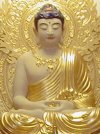
It has been an honor and a humbling learning experience for me to translate sūtras from Chinese into English. For the generous help I have received, I thank the following beneficent learned friends: Dharma Masters Shi Huiguan (釋慧觀), Shi Hongzheng (釋宏正), and Shi Yinhai (釋印海), who discussed with me some passages in a few Chinese texts; Bruce Long and Linda Pheiffer Pauwels, who read the first draft of Sūtra 1; Alisa Kanouse, who edited the first six sūtras; Anne Moses, who edited the first twenty sūtras; Stephen Colley, who has been editing my translations beginning with Sūtra 21; Kottegoda S. Warnasuriya, who helped correct errors in the texts of the mantras; Avinash Sathaye, who with infinite patience further edited the mantras; Avinash Sathaye, who with infinite patience further edited the mantras, and in 2016 kindly helped me with a Sanskrit passage related to Sūtra 14; Carol Fong, who provided, for the heading of this website, a picture of the Buddha statue at the Ch’an Meditation Center, Elmhurst, NY; John C. Gilson, who kindly answered my elementary questions about webpage construction and his online HTML Tutorials; Nandu Abhyankar, who in 2012 sent me the recording of his mantra recitation; Seetha Lath, who in 2008 made two audio recordings for the Sanskrit alphabet on my website, and in 2021 generously helped me with my Sanskrit pronunciation of the eleven mantras; visitors to my website, who appreciate the teachings of the Buddha; earlier translators, who have benefited readers and inspired later translators.
I especially thank Rider Cheng (鄭勝一), who unwittingly dropped a seed into my mind on November 15, 2004. That morning, he had me recite with him three times the Chinese version of the Buddha-Crown Superb Victory Dhāraṇī (the romanized Sanskrit version is in Sūtra 1 as well as Mantra 1 on this website), in honor of my late mother. This seed lay dormant for a year and then took more than a year to germinate into this website, which began on April 21, 2007 with only seven sūtras.
Any flaws in my English translations are my sole responsibility. May the merit of all contributors be transferred to all sentient beings for their rebirth in the Western Pure Land of Ultimate Bliss and for their ultimate enlightenment!